


Cambered Swiss bar. Football bar. Multi-grip bar. Neutral grip bar. Call it what you want.
These are all variations of the same unique-looking barbell. This specialty bar was originally designed to allow athletes to continue bench pressing heavy with a reduced risk of shoulder injury. And while the neutral-grip hand variations (palms facing each other rather than away from the body) of this barbell are gentler on the shoulders when you bench press, there’s a ton more a Cambered Swiss Bar is great for. In fact, it's arguably one of the most underrated barbells out there. If you own a REP cambered swiss bar, you can tap into even more pressing, pulling, and lower-body options.

Here’s a closer look at the Cambered Swiss Bar and why you should incorporate it into your workouts—and also how.
Bet you haven’t tried all these exercises before. (Yeah, that’s a challenge!)
WHAT IS A CAMBERED SWISS BAR

The Cambered Swiss Bar has a loadable sleeve on each side (like a regular barbell), but with a ladder-like design in the middle. Often, some of those “rungs” are angled to create various grip options.
REP’s Cambered Swiss Bar is designed for greater range of motion. The camber offsets the weight from being in line with the bar, creating a pendulum effect, so you must engage more muscles to stabilize the bar, creating a different stimulus than a traditional barbell. The outermost handle creates a deficit. The deficit allows you to pull the bar down in a larger range of motion. On the REP bar, those outer handles are at a deficit and slight camber, so you get both.
CliffsNotes definition:
- Camber: Curve or bend in the bar that offsets the weight, creating an unstable, pendulum effect.
- Deficit: Larger range of motion.
WHY LIFTERS LOVE THE REP® CAMBERED SWISS BAR
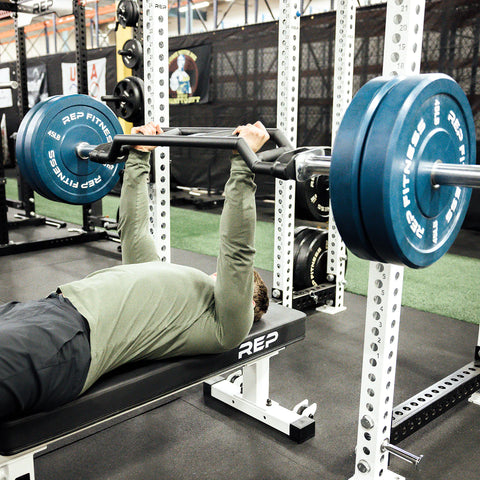
The design of the Cambered Swiss Bar reduces the stress on your shoulders and wrists. At the same time, it demands more of your triceps. This makes it optimal for people with shoulder issues or a limited range of motion. It also is great for bodybuilders who want to pinpoint more specific muscles. If you’re programming hypertrophy, the REP cambered swiss bar gives you stable, neutral-grip options with added range to hit new angles.
Ego check: Since the Cambered Swiss Bar demands more triceps (smaller muscles) than pecs and shoulders, you probably won’t be able to lift as much as you normally can on a straight bar.
Here are some more reasons people love the Cambered Swiss Bar:
- It keeps your wrists neutral, so they can’t "break" backward (a common technical problem with benching with a straight bar).
- It can improve your lockout by building your triceps strength, a critical component of that top range of motion on the bench press.
- It’s versatile for different sized lifters, thanks to the different handle widths.
- It’s less expensive than many other pieces of specialty equipment, especially considering its versatility.
HOW TO USE THE CAMBERED SWISS BAR
The Cambered Swiss Bar is known as a bench press accessory/alternative. Choose between the different handle widths and angles to change the emphasis. Add chains or bands to change it up. On a REP® cambered swiss bar, you can also take advantage of the built-in eyebolt for cable work, plus rackable length for controlled setups.
HOW TO DO A CAMBERED SWISS BAR BENCH PRESS
- Set up the bench under the cambered bar in a power rack or bench station.
- Position the bar so the cambered part hangs lower than a standard barbell.
- Lie flat on the bench with your feet planted firmly on the floor.
- Grip the bar at shoulder-width or slightly wider, ensuring your wrists are straight and elbows are aligned.
- Unrack the bar, keeping your core tight and shoulders retracted.
- Lower the bar slowly, allowing the camber to bring the bar deeper toward your chest, but without bouncing or losing control.
- Pause briefly at the bottom to maintain tension.
- Press the bar up, extending your arms fully and locking out the elbows.
- Repeat for desired reps, maintaining control and form throughout the movement.
This movement allows for a greater range of motion and deeper stretch in the chest, so start with a lighter weight to get used to the camber.
TOP EXERCISES WITH THE REP® CAMBERED SWISS BAR
PULLS & ROWS:
Lat pulldowns (if your bar has an eyebolt to connect to a cable—REP’s does!)

Seal rows

Low rows/bent-over rows/Pendlay rows
PRESSES:

Overhead press
ARMS:

Skull crushers
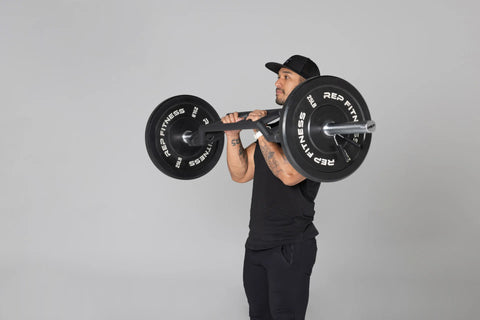
Hammer curls
Add these to your plan for variety and targeted work: cambered bar tricep extension, cambered bar preacher curls, and close-grip neutral curls. The neutral handles reduce wrist strain and help you load the movement safely.
LOWER BODY:
Front squats and Zerchers feel more shoulder-friendly with neutral handles. You can also do a cambered bar squat for a new stimulus. The deficit lets you control depth while keeping the torso more upright than a straight bar.
HOW TO DO CAMBERED BAR CURLS
- Choose a cambered (EZ) bar with the desired weight and grip it at the angled sections for comfort and wrist alignment.
- Stand upright, feet shoulder-width apart, with a slight bend in your knees and your core engaged.
- Hold the bar in front of your thighs with an underhand grip (palms facing up), keeping your elbows close to your sides.
- Curl the bar upward by flexing your elbows, keeping your upper arms stationary.
- Focus on squeezing your biceps at the top of the movement without letting your elbows drift forward.
- Lower the bar slowly, controlling the descent and fully extending your arms without locking your elbows.
- Repeat for desired reps, keeping your form tight and avoiding swinging or using momentum.
The cambered bar helps reduce strain on the wrists and allows for a more comfortable and effective bicep workout. For even more isolation on the biceps, set up cambered bar preacher curls on a preacher bench, or use an incline bench as a pad. Cambered bar preacher curls emphasize the mid-range and peak squeeze with strong wrist alignment.
TRICEPS WITH A CAMBERED SWISS BAR
For long-head triceps bias, try an overhead cambered bar tricep extension on a flat or incline bench. Keep the elbows tucked, pause just behind the head, then drive to lockout. A cambered bar tricep extension also works well with the bar connected to a cable via REP’s eyebolt for constant tension.
LOWER BODY WITH A CAMBERED SWISS BAR
Work your quads and core stability with a cambered bar squat using the neutral inner handles. Keep the chest tall, brace hard, and control the descent. Rotate in front squats and Zercher squats to vary torso angle and loading. A cambered bar squat pairs well with split squats for balanced leg training.
MORE WAYS TO USE A CAMBERED SWISS BAR
- Ab rollouts
- Incline presses
- Floor presses
- Front squats
- Zercher squats
- Front raises
- Clean and presses (narrow grip)
- Chin-ups (place the bar on top of a squat rack)
- Jammer presses
- Suitcase carries
- Pullovers
- Stiff-legged deadlifts
- Single-leg deadlifts
- JM Presses
- Inverted rows (put the bar on your rack safeties)
WANT MORE OF A CHALLENGE?
Try this with presses and other relevant exercises: Press to near-failure (or a certain rep range), then immediately move to medium width, then wide grip.
Tip: Look for a Cambered Swiss Bar with knurling to help with grip on heavier lifts, especially pulling movements. Bonus points if you can find a Cambered Swiss Bar that’s long enough to rack on a power rack. This will help with loading weights and getting into optimal form for many of the exercises.
RELATED READING
- Build a stronger chest and a bigger bench press
- Specialty barbells: how to use them and why
- Zercher squat
- Can’t or don’t want to barbell back squat? Here are 18 alternatives to try instead
- Hypertrophy training
FAQs
What exercises can I do with a Cambered Swiss Bar?
Start with bench press, overhead press, and rows. Add skull crushers, hammer curls, cambered bar preacher curls, and a cambered bar tricep extension. For legs, rotate front squats, Zerchers, and a cambered bar squat.
How does the Cambered Swiss Bar benefit my workouts?
The camber increases range of motion and instability for more muscle recruitment. Neutral handles reduce wrist and shoulder stress, and the REP cambered swiss bar adds rackable length and an eyebolt for cable variations.
Can I squat with a Cambered Swiss Bar?
Yes. Use the inner neutral handles for a comfortable cambered bar squat. You can also perform front squats and Zercher squats for different torso angles and quad emphasis.
Is the Cambered Swiss Bar good for arm training?
Absolutely. Perform cambered bar preacher curls for targeted biceps work, and use a cambered bar tricep extension—flat, incline, or overhead—to build lockout strength and long-head triceps size.
Aimee Heckel, CPT, is a health and fitness journalist with over 20 years of experience. She set an all-time world-record deadlift in her division across all powerlifting federations at Mr. Olympia. In addition, she earned a national deadlift record and 18 Colorado state records. Heckel also has nine world records in grip sport, a pro card in natural figure bodybuilding, four first-place bodybuilding titles, and was named IPE Ms. Colorado Figure.
This article was reviewed by Rosie Borchert, NASM-CPT, for accuracy.
similar to this

Postpartum Cardio: How to Get Your Heart Rate Up Again After Baby
New baby, new game plan.

Cardio vs Conditioning: Which One Do You Need?
Heart health or high performance?
NEWSLETTER SIGNUP
Product launch information, promotions, blogs, and REP news.