


Training to protect and serve.
Police work is physically unpredictable. One moment an officer is sitting in a patrol car writing reports; the next, they may be sprinting after a suspect, climbing a fence, wrestling a combative individual into custody, or dragging someone to safety often while carrying 30–50 pounds of gear. This unpredictability demands more than general fitness.
Nearly twenty years ago when I first entered law enforcement, “tactical fitness” was in its infancy. Most police academies relied on traditional fitness assessments like the 1.5-mile run and max push-ups and sit-ups. Those basic exercises produced fit recruits, but they didn’t prepare officers for the unpredictable, high-stress realities of the job.
Today, police training has matured. We now recognize that police officers are tactical athletes: professionals whose physical readiness can mean the difference between life and death. Readiness matters. Strength matters. Conditioning matters. And unlike conventional gym-goers, officers must be capable anytime, anywhere, under any conditions.
This article breaks down the 5 Mandatory Exercises for Law Enforcement according to the experts. We will cover the muscles worked, how to complete the moves with proper form, walk through some variations, and show you how to include it in your next workout.
Why Tactical Fitness Matters
Police officers often spend 70-80% of their shift in sedentary activity (sitting in their car, performing traffic stops, writing reports), interrupted by sudden, explosive bursts of action. This constant “zero to one hundred” demand requires specialized training that traditional Olympic and Powerlifting cannot provide.
What makes it a bit harder for police officers is that they carry 20 to 50 pounds of external load on their person during their shift. That weight significantly increases biomechanical stress on the spine hips, and knees and reduces mobility and acceleration. It also diminishes balance and relative strength.
“Tactical athletes must possess the tactical skills, physical ability, speed, conditioning, and strength to thrive on a long-range mission or long standoff," says Bryant. To meet those demands, a program for officers needs to:
- Build absolute and relative strength (lifting heavy while moving under load)
- Develop power and explosiveness
- Improve repeated high-intensity effort
- Support a solid aerobic base for recovery
[Read More: Top 5 REP Fitness Tools Every Police Department Gym Needs]
The Best Workouts for Police Officers
In addition to having the best equipment for first responders, here are the training methods Bryant recommends for officers.
Plyobox Training: Building Explosive Power

Plyometric work improves lower-body explosiveness, coordination, and elasticity, which is valuable for sprint starts, jumping over fences, and changing direction under chase. More importantly, plyometric training prepares the tactical athlete to absorb and redirect force, a crucial trait when struggling with a resisting subject.
“Plyometric training builds explosive power and bridges the gap between the weight room and the field," says Bryant. "Plyobox jumps unlocks the triple-extension movements which is paramount to an explosive tactical athlete.”
Exercises: Box jumps (front, lateral), depth jumps, lateral bounds.
Programming:
- After warming up and before squats to focus on speed and height.
- Immediately after heavy squats to focus on endurance.
Coaching cues:
- Land quietly, absorb with hips and knees, and immediately rebound.
- Start with moderate height (12–18″) and progress only when form is solid.
- Keep the volume modest (3–5 sets of 3-6 reps) to preserve speed and reduce injury risk.
Weight Vest Training: Functional Load Conditioning

Training with weight vests is one of my favorite things to do. It simulates duty gear and teaches you to move efficiently while carrying external weight. This is not bodybuilding; it’s occupational rehearsal. Your goal as a tactical athlete is to mimic the environment that you operate in, using a controlled, thoughtful process to reduce the risk of injury.
Before you begin, weigh yourself with full gear so you know your baseline. Then, for conditioning and general strength work, Bryant recommends adding 15–25% more than your typical-duty load, but only when appropriate.
Exercises:
- Rucking (walking) with a 20-30lb vest or equivalent gear — builds posterior chain and load tolerance.
- Weighted pullups with vest — builds upper-body strength and grip under resistance.
- Rotational landmine drills using weighted vest — builds core stability and movement control under load.
Programming:
- Ruck on active recovery days.
- Supplement weight vest instead of dip weight belt for dips and pullups.
- Use while doing landmine movements or twisted back extension.
Coaching cues:
- Avoid ego lifting. Only work within your range
- Every third ruck, go heavy. Avoid rucking heavy each time.
Sandbag Training: Grip and Core Stability

One of the most underrated tools of tactical training is sandbag training. Their shifting, awkward load mimics the unpredictability of real-life police encounters.
“I love using sandbag training with tactical athletes because the required strength in the field is rarely used in a linear fashion," says Bryant. "Because of the uncooperative nature of the sandbag, your body must work overtime to use muscles for stabilization which is one of the reasons why it’s so beneficial for core and trunk strength.”
Sandbags are unstable loads that teach control, grip, and full-body coordination. This is functional strength at its best. Sandbags are easily scalable by adding weight or simply adjusting the way you pick them up.
Exercises: Front squats, sandbag to shoulder or over the shoulder, carries (front, across shoulder, over shoulder), overhead press.
Programming:
- At end of each workout as a finisher.
- On separate carry or movement day. Pairs perfectly with yoke or farmers walks, and ab workouts.
Coaching cues:
- Use leg drive and a braced core.
- Breath throughout the entire exercises.
- As proficiency improves, progress toward dynamic throws and rotational movements.
Trap Bar Jumps: Power and Acceleration
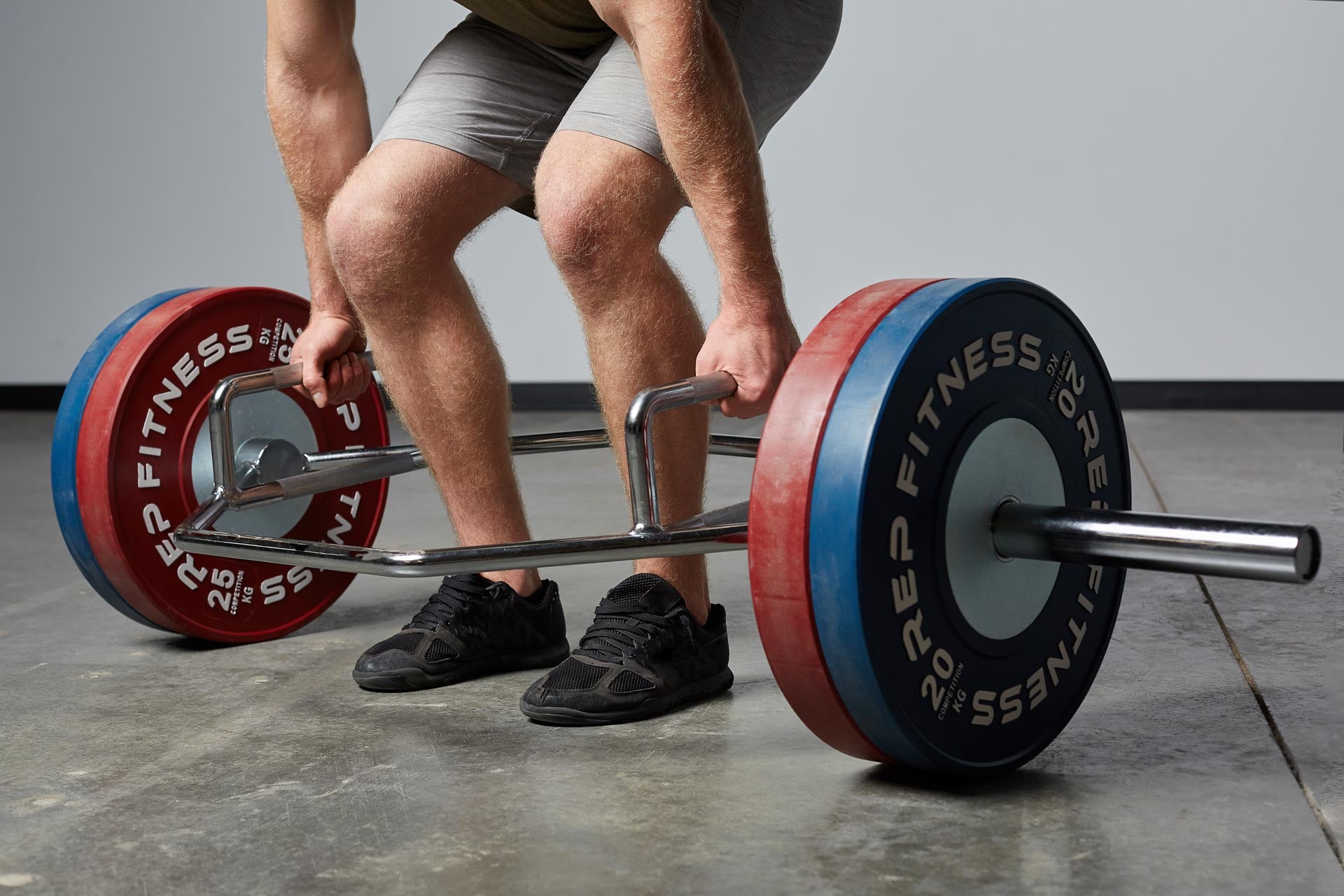
Trap bar jumps merge strength and speed by training explosive hip extension. Weighted jumps focus on fast-twitch (Type IIx) fibers and put a significant strain on your central nervous system, which can help prepare you for heavier lifts later in the week. More importantly, it can help officers generate ground force, which is critical in foot pursuits, takedowns, and sudden directional changes.
Exercises: Trab Bar Jumps, calf raise (explosive up, very slow on the eccentric)
Programming: 3-5 sets of 3-5 jumps, rest long (2-4 minutes) to keep speed. Focus is on velocity, not loading heavy.
Coaching Cues:
- Light load (25-35% of deadlift max) on a trap bar.
- Pause at the bottom, then explode upward into a vertical jump, holding the bar handles, land softly, reset.
- Start very light (just the bar for beginners) and progress slowly.
[Read More: 14 Benefits of an Open Trap Bar]
Sprints: Conditioning for Pursuit and Recovery

Police work is defined by long periods of low activity punctuated by short, intense bursts. Sprinting is the closest training analog to that operational reality. Your goal is to move very quickly and recover quickly and to maintain mechanics under stress.
Exercises:
- 10-40 yard all-out sprints, 6-10 rounds, rest 45-90 seconds between each.
- Hill sprints (with or without vest) for load and incline stress.
- Shuttle or change-of-direction sprints to simulate pursuit scenarios.
Programming:
- At end of ruck day or stand on it’s own day.
- As finisher for leg day.
- During a workout to increase heart rate. Pairs great with lighter sandbag workout and carry days.
Coaching Cues:
- Slowly add a weight vest that mimics your ballistic vest and equipment load.
- Move to flatter ground. Do not start on flatter ground if you are starting sprint training.
Takeaway
Tactical fitness allows officers to maintain strength without sacrificing the agility, endurance, and resilience the job requires. You can layer carries, sprints, crawls, jumps, and rucking work into your existing program as stand-alone sessions or as finishers after big compound lifts, depending on your needs. Play around with what works for you.
“Being a tactical athlete is about being prepared for the unexpected, the kind that lurks in dimly lit gas stations and the back alleys of life. Be Gas Station Ready," says Bryant.
It is not about chasing muscles; it’s about functional strength, speed, endurance, and resilience. Your job is simple: train for the worst, so when life gets messy, you are already ready.
Joshua Lee is an active-duty police sergeant in Arizona with nearly two decades of law enforcement experience, where he has developed a particular emphasis on officer performance and wellness. In addition to his operational responsibilities, Lee serves as a professor of law and technical writing and is an ISSA Tactical Conditioning Specialist. After a back injury, he transitioned from powerlifting and Olympic-style lifting to strongman and tactical conditioning, adapting his training to better match the realities of duty work. He brings a practical, field-tested perspective to first responder wellness.
This article was reviewed by Rosie Borchert, NASM-CPT, for accuracy.
similar to this

Cardio vs Conditioning: Which One Do You Need?
Heart health or high performance?

Master the Pallof Press for a Stronger, More Stable Core
It only looks easy.
NEWSLETTER SIGNUP
Product launch information, promotions, blogs, and REP news.